Hi, my name is
Abdellah Rahmani.
I make AI |
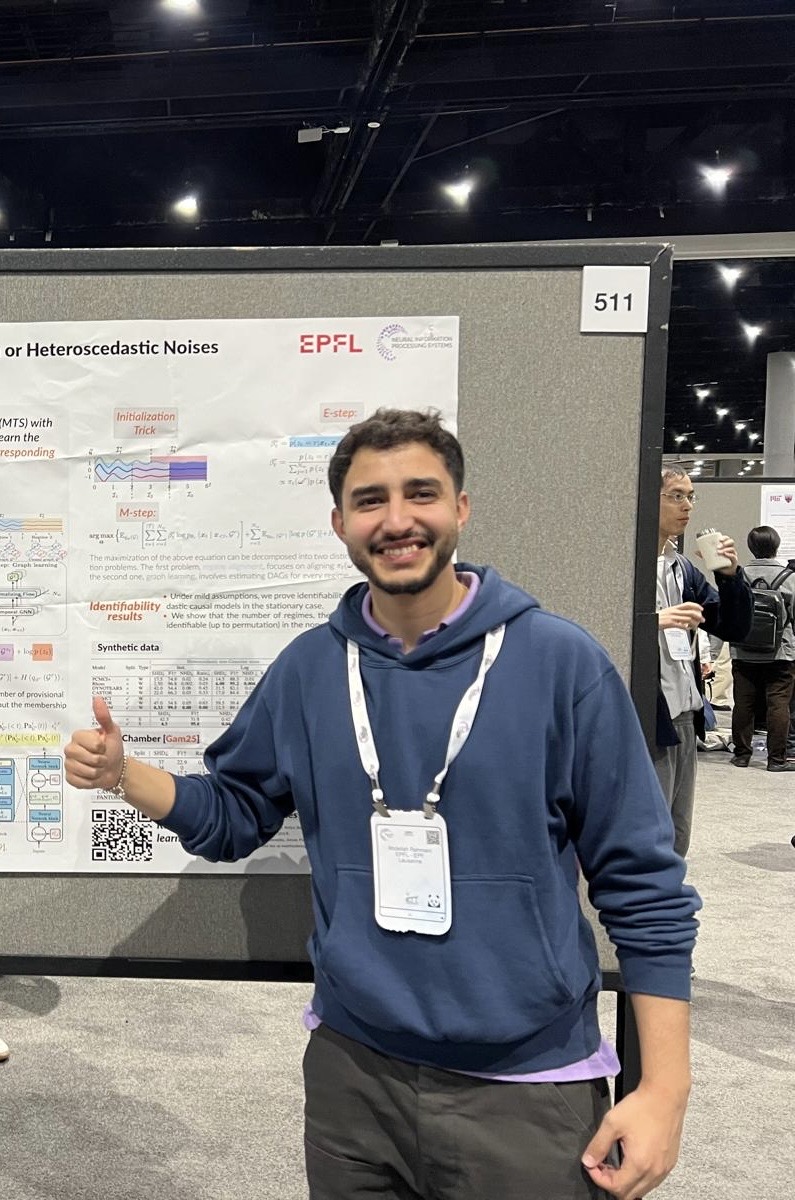
PhD candidate at EPFL and Student Researcher at Google DeepMind. I study how models structure and allocate computation, from causal time series to adaptive reasoning.
View my work01.About Me
I am a PhD candidate at EPFL, advised by Prof. Pascal Frossard. My research asks how sequence models should structure and allocate their computation.
My early work on Meta-GNN explored how to personalize seizure detection to each patient with just a few adaptation steps. I then developed CASTOR, FANTOM, and Cheesefill to learn causal structure in multivariate time series, including non-stationary data and incomplete observations.
Today, I bring conditional computation to foundation models through deep recurrent architectures, dynamic routing, and test-time scaling. In Library of Layers (LoL), we let a model choose the order of its transformer layers at runtime, adapting its computation to the problem at hand.
I am also a Student Researcher at Google DeepMind in London, working on in-context and prequential learning for LLMs. Before EPFL, I completed the MVA master's at ENS Paris-Saclay with highest honors and worked on cross-domain recommendation at Deezer Research.
A few topics I work on:
- Causal structure learning
- Temporal data & missingness
- Dynamic layer routing
- Test-time scaling
- In-context & prequential learning
- Meta-learning
Outside research, I write and rap, play football and padel, and swim.
- PhD candidate · EPFL, Lausanne
- Google DeepMind, London · Aug–Dec 2026
- Arabic: native · English & French: fluent
Tools I use
- Python, MySQL, Java, Spark
- PyTorch, JAX, Keras
- Unix, Git, Docker
A little character in my research
Meet the projects. Pick a companion to hear its side of the story.
“Same layers. A different path for every problem.”
— LoL, Library of Layers02.Publications
Library of Layers (LoL): Adaptively Ordering Transformer Layers at Runtime
A learned router selects the next transformer layer from a shared library. Changing the library size connects layer reuse and sparse computation; learned layer orders reflect different solution strategies and language patterns.
Causal Heteroscedastic Structure Learning from Incomplete Temporal Data
Learns causal structure from incomplete multivariate time series with heteroscedastic noise, addressing missing observations and changing noise variance.
Flow Based Approach for Dynamic Temporal Causal Models with Non-Gaussian or Heteroscedastic Noises
Uses normalizing flows to learn temporal regimes and their causal graphs from multivariate time series with non-Gaussian or heteroscedastic noise.
Causal Temporal Regime Structure Learning
Jointly discovers temporal regimes and the causal graph governing each one in non-stationary multivariate time series.
A Meta-GNN Approach to Personalized Seizure Detection and Classification
A meta-learned graph neural network for patient-specific seizure detection and classification, personalized with only a few adaptation steps.
03.Experience
Student Researcher @ Google DeepMind
Aug 2026 — Dec 2026 · London
- Researching in-context and prequential learning for large language models.
Doctoral Assistant @ EPFL (LTS4)
Aug 2022 — Present · Lausanne
- Studying efficient AI reasoning across modalities, advised by Prof. Pascal Frossard.
- Learning causal structure from non-stationary and incomplete temporal data.
- Developing dynamic routing and deep recurrent architectures for text and vision.
Research Scientist Intern @ Deezer Research
Apr 2021 — Sep 2021 · Paris
- Explored podcast recommendation using listeners' music consumption patterns.
- Implemented cross-domain recommendation methods using domain adaptation and meta-learning.
Applied Scientist Intern @ Silex France
Apr 2020 — Sep 2020 · Antibes
- Explored graph embeddings for search engines.
Part-time Researcher @ CRIStAL
Oct 2019 — Mar 2020 · Lille
- Applied domain adaptation to deep learning models for image-manipulation detection, under the guidance of Patrick Bas.
Data Science Intern @ Forafric Maroc
Apr 2019 — Aug 2019 · Casablanca
- Built machine learning models to identify crops from satellite images.
04.Education
-
2022 — Present
PhD, Electrical Engineering — AI & Machine Learning
EPFL, Lausanne -
2020 — 2021
MSc, Mathematics, Vision, Learning (MVA)
ENS Paris-Saclay · Highest honors -
2019 — 2020
Final-year Engineering, AI & Data Science
École Centrale Lille · Top 10% of 280 students
Additional mathematics at the University of Lille: functional analysis, stochastic processes, and high-dimensional probability. -
2017 — 2019
Master of Engineering, Data Science & AI
École Centrale Casablanca -
2014 — 2017
Classes Préparatoires
Meknès · Intensive preparation for engineering schools · Rank 104 / 3,000
05.Honors, Teaching & Service
Awards
- Doc.Mobility Grant — CHF 7,000, EPFL Doctoral School, for deep recursive models in collaboration with Columbia University
- 3rd place — My Thesis in 180 Seconds, EPFL EDEE
- Master's Valorization Scholarship — CHF 10,000, EPFL LTS4
- Top 10% of 280 students — École Centrale Lille
- Top student among 30 — Fleurs d'Orangers High School, Meknès
Service
- Reviewer — NeurIPS, ICLR, ICASSP
- Evaluator — ELLIS PhD program
Teaching & Supervision at EPFL
- Network Machine Learning — Spring 2023, 2024, 2025
- Signal Processing — Fall 2025
- Optimization — Fall 2023
- Linear Algebra — Fall 2022
- Supervised 2 student projects on representation learning from EEG data — Spring 2023 and Fall 2024
Kaggle Challenges
- 3rd of 70 teams — DNA sequence classification for transcription factor binding sites using kernel methods, ENS Paris-Saclay · Mar–Apr 2021
- 1st of 10 teams — Hand gesture recognition using deep learning, Centrale Lille · Mar–Apr 2020
06.Blog
Adaptive Layer Execution: Learning to Order Computation in Language Models
Adaptive Layer Execution (ALE) uses a shared router to choose which transformer layers to call, in what order, and how often. By reusing a pool of layers across recurrent steps, it adapts computation to each input while keeping the model parameter-efficient.
Get In Touch
Interested in adaptive computation, causal structure learning, or efficient foundation models? I'm happy to exchange ideas and discuss research collaborations.
Say Hello